Last reviewed: 16 September 2026
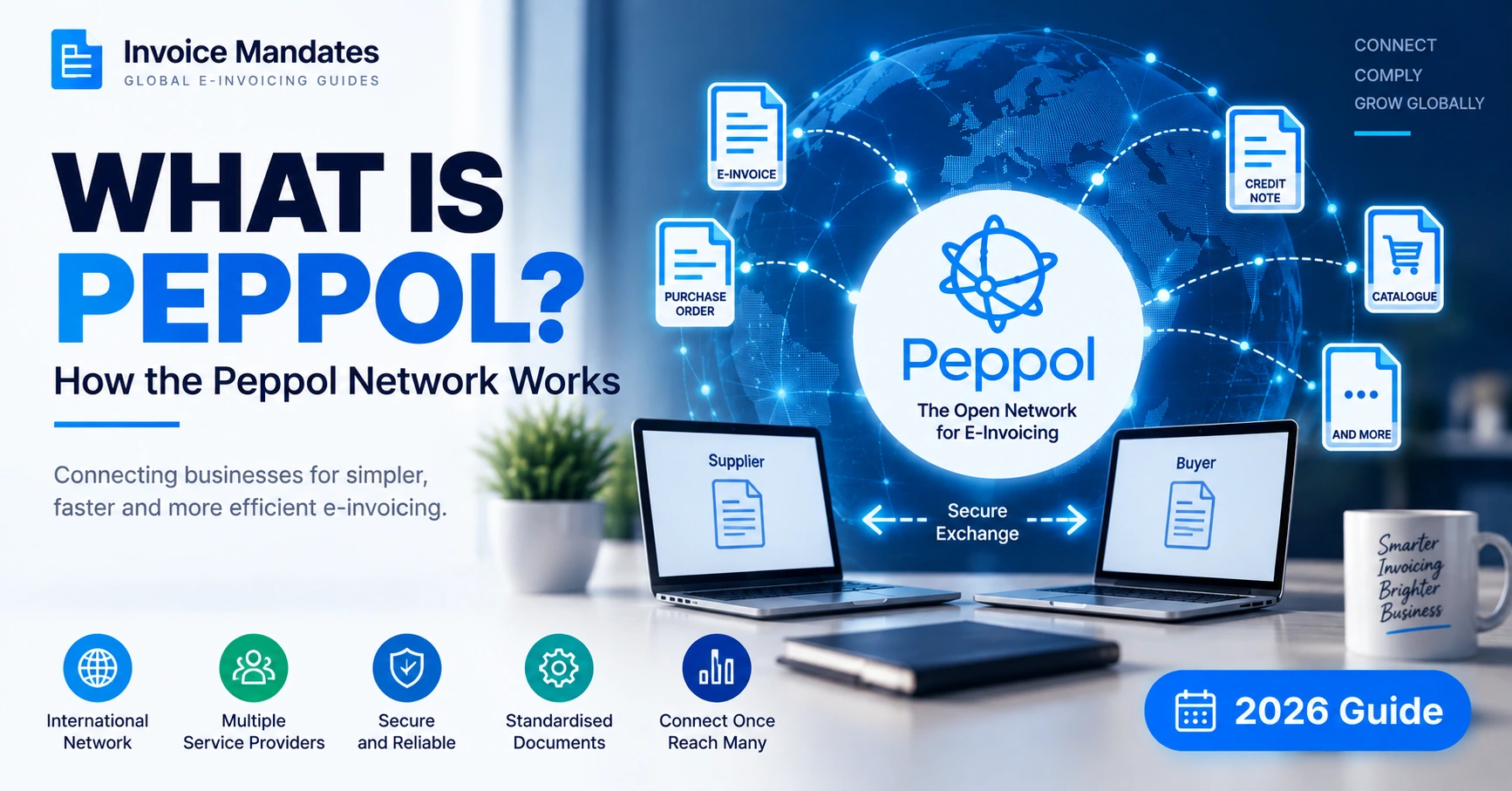
Peppol is an international interoperability framework and network that allows businesses and public organisations to exchange structured electronic business documents, including e-invoices, purchase orders and other procurement documents.
Peppol is not a single government portal and it is not an invoicing software company. Instead, organisations connect through approved service providers that use common technical standards so different accounting and ERP systems can exchange documents securely.
Quick answer: Peppol connects businesses through certified service providers. A sender can use one provider and a receiver can use another, while the Peppol framework allows the two systems to exchange structured documents using shared standards.
What does Peppol mean?
Peppol originally developed from a European public procurement project that began in 2008. The project later evolved into a broader international framework for exchanging electronic business documents.
Today, Peppol is governed by OpenPeppol, a non-profit international association based in Belgium.
It is useful to distinguish the two names:
- Peppol refers to the interoperability framework, network and specifications; and
- OpenPeppol is the organisation responsible for developing and governing the framework.
What is the Peppol Network?
The Peppol Network is a system that allows organisations using different software providers to exchange standardised electronic business documents.
A company does not usually connect directly to every customer or supplier. Instead, it connects to a Peppol-certified service provider. That provider then connects to other Peppol-certified providers across the network.
This approach is based on a principle often described as connect once, reach all.
Once an organisation is connected through a suitable Peppol service provider, it can exchange supported documents with other Peppol-enabled organisations without building a separate technical connection for every trading partner.
How does Peppol work?
Peppol uses what is commonly called a four-corner model.
| Corner | Role |
|---|---|
| Corner 1 | The supplier or sender of the business document |
| Corner 2 | The sender’s Peppol-certified service provider |
| Corner 3 | The receiver’s Peppol-certified service provider |
| Corner 4 | The buyer or recipient of the document |
A simple e-invoice exchange can therefore work like this:
- The supplier creates an invoice. The invoice is generated in accounting, billing or ERP software.
- The supplier sends it to its service provider. The provider acts as Corner 2.
- The provider validates the document. The invoice is checked against the relevant Peppol specifications.
- The receiving organisation is identified. Peppol addressing and capability services determine where the document should be sent and which document types the recipient supports.
- The invoice is delivered to the recipient’s provider. This is Corner 3.
- The recipient receives the invoice. The buyer’s system can import and process the structured data.
OpenPeppol describes this model as an open network where organisations can choose different providers while remaining interoperable. :contentReference[oaicite:0]{index=0}
What is a Peppol Access Point?
A Peppol Access Point is a service that connects an organisation to the Peppol Network.
Businesses normally access Peppol through a Peppol-certified service provider rather than building a direct connection themselves.
The service provider can handle functions such as:
- sending Peppol documents;
- receiving Peppol documents;
- validating document formats;
- routing documents to the correct recipient;
- publishing receiving capabilities; and
- integrating Peppol with accounting or ERP software.
OpenPeppol maintains a current list of certified service providers. :contentReference[oaicite:1]{index=1}
Does a business need the same provider as its customer?
No.
This is one of the main reasons Peppol is useful.
A supplier can choose one Peppol-certified provider while its customer uses another provider. The two service providers communicate through the Peppol Network using common technical specifications.
This differs from a closed system where every participant may need to use the same platform.
OpenPeppol explains that the four-corner model allows buyers and suppliers to choose their own providers while remaining connected to the wider network. :contentReference[oaicite:2]{index=2}
What is a Peppol ID?
A Peppol participant needs an electronic identifier so documents can be routed to the correct organisation.
This is often informally called a Peppol ID.
The actual identifier can be based on a recognised business identifier scheme, depending on the country and implementation.
For example, a country may use:
- company registration numbers;
- VAT or tax identifiers;
- government business numbers; or
- other approved participant identifiers.
The business’s service provider usually handles registration and configuration of the participant identifier.
How does Peppol find the correct recipient?
Peppol uses addressing and capability lookup services to determine where a document should be sent.
Two important concepts are:
SML
The Service Metadata Locator, or SML, helps locate the service that contains information about a participant’s receiving capabilities.
SMP
A Service Metadata Publisher, or SMP, publishes information about the document types and processes a participant can receive.
These services allow the sender’s provider to determine whether the recipient is registered and which supported document types can be delivered.
OpenPeppol describes addressing, capability lookup, Access Points and public-key infrastructure as core elements of the network. :contentReference[oaicite:3]{index=3}
What documents can be sent through Peppol?
Peppol is commonly associated with electronic invoicing, but it can support more than invoices.
Depending on the relevant Peppol specifications and local implementation, organisations can exchange documents such as:
- electronic invoices;
- credit notes;
- purchase orders;
- order responses;
- catalogues;
- despatch advice;
- procurement documents; and
- other structured business messages.
Peppol Business Interoperability Specifications, commonly called Peppol BIS, define how supported business documents are structured and exchanged. :contentReference[oaicite:4]{index=4}
What is Peppol BIS?
Peppol BIS stands for Peppol Business Interoperability Specifications.
These specifications define how particular business documents and processes should work across the Peppol Network.
They help ensure that two organisations using different software can interpret the same invoice or other document consistently.
Peppol BIS uses standardised structured data and commonly builds on UBL standards for many business document types. :contentReference[oaicite:5]{index=5}
Is Peppol the same as UBL?
No.
UBL is a structured document standard. Peppol is a broader interoperability framework that covers document specifications, addressing, security, routing and governance.
A useful way to think about it is:
- UBL: helps define how invoice data is structured;
- Peppol BIS: defines how that structured data should be used for a particular business process; and
- Peppol Network: provides the framework for securely exchanging the document between organisations.
Is Peppol an e-invoicing software?
No.
Peppol itself is not an accounting application, billing platform or government invoicing portal.
OpenPeppol specifically describes Peppol as an enabler rather than a provider of exchange services. Organisations access the network through Peppol-accredited service providers. :contentReference[oaicite:6]{index=6}
Your accounting or ERP software may include Peppol functionality directly, or it may connect to a separate provider.
Is Peppol a government platform?
No.
Peppol was originally developed through a European project, and governments continue to play an important role in adoption, but Peppol is not one central government invoice portal.
The network is governed through OpenPeppol and operates through certified private and public-sector service providers.
Individual countries can also appoint a Peppol Authority to govern local implementation and requirements.
What is a Peppol Authority?
A Peppol Authority is an organisation responsible for supporting and governing Peppol implementation within a country or jurisdiction.
A Peppol Authority can help manage:
- local service-provider requirements;
- participant rules;
- national specifications;
- local identifiers;
- compliance requirements; and
- coordination with OpenPeppol.
Countries can therefore use the common Peppol framework while adding local requirements needed for their own invoicing or tax systems.
Which countries use Peppol?
Peppol began in Europe but is now used internationally.
OpenPeppol notes adoption across European countries and in markets including Singapore, Australia, New Zealand and Japan. :contentReference[oaicite:7]{index=7}
Different jurisdictions use Peppol in different ways.
Examples include:
- Belgium: Peppol is central to the domestic structured B2B e-invoicing framework;
- Singapore: InvoiceNow is based on the Peppol framework;
- UAE: the developing e-invoicing model uses OpenPeppol-based interoperability;
- Australia and New Zealand: Peppol supports electronic invoicing initiatives; and
- several European countries: Peppol is used in B2G, B2B or both.
However, the presence of Peppol in a country does not automatically mean every business is legally required to use it.
Is Peppol mandatory?
Peppol itself is not universally mandatory.
Whether a business must use Peppol depends on the rules of the country, transaction type and customer.
A jurisdiction may:
- require Peppol for certain public-sector invoices;
- use Peppol as the standard route for domestic B2B e-invoicing;
- allow Peppol as one of several permitted networks; or
- support Peppol voluntarily without making it mandatory.
Always check the relevant country rules rather than assuming that Peppol is compulsory everywhere.
Peppol vs a government e-invoicing portal
| Feature | Peppol | Central Government Portal |
|---|---|---|
| Structure | Distributed network of certified service providers | Usually one centrally managed system |
| Provider choice | Businesses can usually choose a certified provider | Users may need to connect directly to the government platform |
| International use | Designed for interoperable domestic and cross-border document exchange | Usually focused on one jurisdiction |
| Main role | Exchange structured business documents | Can exchange, validate, clear or report invoices depending on the country |
Is Peppol the same as KSeF or SDI?
No.
National platforms such as Poland’s KSeF and Italy’s Sistema di Interscambio (SDI) are country-specific systems.
Peppol is an interoperability network that can operate across jurisdictions and providers.
A business operating internationally may therefore need to support both Peppol and separate national platforms depending on where it invoices customers.
How is Peppol different from emailing a PDF?
Emailing a PDF usually involves sending a document designed primarily for a person to read.
Peppol exchanges structured business data that compatible systems can process automatically.
This can reduce the need for:
- manual invoice entry;
- OCR extraction;
- retyping tax information;
- manual document routing; and
- separate integrations with every trading partner.
Read our E-Invoice vs PDF Invoice guide for a fuller comparison.
Benefits of using Peppol
One connection to many trading partners
A business generally connects through one certified provider rather than creating separate technical connections to every customer and supplier.
Interoperability
Different accounting systems and service providers can exchange standardised documents using common specifications.
Automation
Structured documents can flow directly into accounting, procurement and approval systems, reducing repetitive manual work.
International reach
The Peppol framework is used across multiple countries and supports both domestic and cross-border electronic document exchange.
Provider choice
Businesses can generally choose the Peppol-certified provider that best suits their technical and commercial requirements.
Standardisation
Common specifications make it easier for organisations to exchange documents consistently.
Does Peppol make invoices automatically compliant?
No.
Using Peppol does not automatically guarantee that an invoice complies with every tax requirement.
The invoice still needs to meet applicable rules regarding:
- mandatory invoice information;
- VAT or tax treatment;
- invoice dates;
- currency;
- customer identifiers;
- country-specific fields;
- local reporting requirements; and
- storage and retention.
Peppol provides the interoperability and transmission framework, while local law determines the actual tax and invoicing requirements.
How to start using Peppol
- Check whether Peppol is relevant. Review the invoicing rules that apply to your country and customers.
- Check your current software. Your accounting or ERP provider may already support Peppol.
- Select a certified service provider. If needed, choose a provider authorised to offer Peppol services.
- Register your participant identifier. Your provider can normally help configure the appropriate Peppol identifier.
- Configure document types. Confirm which e-invoice and other business document specifications you need.
- Integrate your system. Connect your accounting, ERP or billing system to the provider.
- Test sending and receiving. Make sure customer identifiers, formats and routing work correctly.
- Monitor local requirements. Country-specific e-invoicing rules can add additional reporting or validation requirements.
How to choose a Peppol service provider
Before choosing a provider, businesses may want to ask:
- Is the provider currently Peppol-certified?
- Which countries does it support?
- Which Peppol BIS document types are supported?
- Can it integrate with your ERP or accounting software?
- Does it support sending and receiving?
- Does it handle local tax reporting requirements?
- How are failed documents and errors managed?
- What are the implementation and ongoing costs?
- How are documents archived?
- What technical support is available?
OpenPeppol publishes a list of certified service providers that businesses can use as a starting point. :contentReference[oaicite:8]{index=8}
Common Peppol mistakes
- Thinking Peppol is a single website. It is an interoperability framework and network.
- Assuming OpenPeppol sends invoices directly. Businesses normally use certified service providers.
- Thinking every country requires Peppol. Local rules differ.
- Confusing Peppol with UBL. UBL is a document standard; Peppol is a broader framework.
- Assuming Peppol replaces tax rules. Invoices still need to meet local legal and tax requirements.
- Choosing a provider without checking country support. Local implementation and reporting requirements can differ.
Frequently asked questions
What is Peppol in simple terms?
Peppol is a network and set of standards that allows businesses using different systems and service providers to exchange structured electronic documents such as invoices.
Is Peppol an invoicing platform?
No. Peppol itself is not an invoicing platform. Businesses connect through Peppol-certified service providers.
What is a Peppol Access Point?
A Peppol Access Point is a service operated by a certified provider that connects businesses to the Peppol Network and sends or receives structured documents.
Do I need a Peppol ID?
An organisation needs a participant identifier so the network can route documents correctly. The exact identifier depends on the country and identifier scheme.
Do my customer and I need the same Peppol provider?
No. The four-corner model allows sender and recipient to use different certified providers.
Is Peppol mandatory in Europe?
No single rule makes Peppol mandatory for every European business. Requirements differ between countries and between B2G and B2B transactions.
Is Peppol only used in Europe?
No. Peppol has expanded internationally and is used in countries outside Europe, including Singapore, Australia, New Zealand and Japan. :contentReference[oaicite:9]{index=9}
Can Peppol send documents other than invoices?
Yes. Peppol specifications support several business and procurement documents, including orders and other structured messages.
Is Peppol secure?
Peppol uses certified service providers, defined network specifications, addressing services and public-key infrastructure as part of its interoperability framework. Businesses should still evaluate their provider’s own security and compliance controls. :contentReference[oaicite:10]{index=10}
Does Peppol report invoices to the tax authority?
Not automatically in every country. Some national implementations combine Peppol-based exchange with tax reporting, while others use Peppol primarily for document delivery.
Official Peppol resources
- OpenPeppol: About Peppol
- OpenPeppol: Peppol Interoperability Framework
- OpenPeppol: Information for End Users
- OpenPeppol: Certified Service Providers
Continue reading
New to e-invoicing? Start with our What Is an Electronic Invoice? guide.
To understand why an ordinary PDF may not meet a structured invoicing mandate, read our E-Invoice vs PDF Invoice guide.
You can also explore country-specific requirements for Belgium, France, Germany, Singapore and the UAE.
Disclaimer: This article provides general educational information and does not constitute legal, tax, accounting or technical advice. Peppol specifications, provider status and country-specific implementation rules can change. Confirm important requirements with OpenPeppol, the relevant national authority and your chosen service provider.