Last reviewed: 6 August 2026
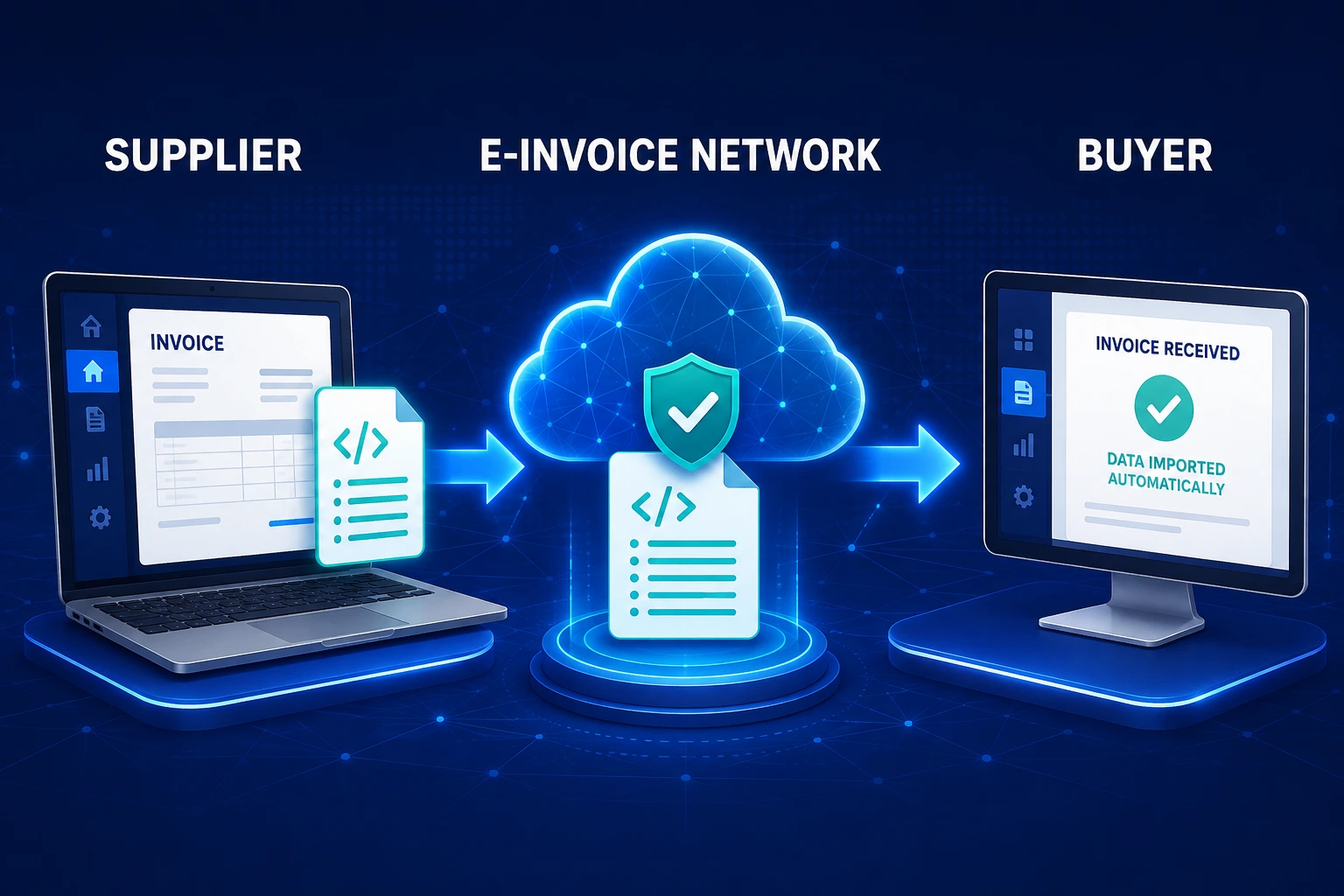
A PDF invoice and an electronic invoice can look almost identical on a screen, but they work very differently. A PDF is mainly designed for a person to read. A structured electronic invoice is designed so accounting systems can receive, validate and process its data automatically.
Quick answer: Emailing a PDF invoice does not necessarily satisfy a structured e-invoicing requirement. Under the definition used by the European Union and many modern tax systems, an e-invoice is issued, transmitted and received in a structured electronic format that enables automatic processing. Always check the rules that apply in the customer’s country.
This guide explains the difference between an e-invoice and a PDF invoice, how each format is processed, when hybrid invoices can qualify, and what businesses should check before changing their invoicing system.
E-invoice vs PDF invoice: the main differences
| Feature | PDF invoice | Structured e-invoice |
|---|---|---|
| Primary purpose | Human viewing and printing | Automatic system-to-system processing |
| Typical format | PDF document | XML using UBL, CII, Facturae or another approved syntax |
| Data structure | Usually unstructured or visually positioned text | Each data element has a defined field and meaning |
| How it is sent | Email, download link or customer portal | E-invoicing network, government platform, approved provider or direct system connection |
| Buyer processing | Manual entry, copy and paste, OCR or data extraction | Direct import, automated validation and workflow matching |
| Error checking | Mostly visual or performed after receipt | Business and format rules can be checked automatically |
| Mandate compliance | May not qualify when structured invoicing is required | Can qualify when it uses the required format, channel and process |
| Readable by people | Yes | Usually displayed through a viewer or accompanied by a readable rendering |
What is a PDF invoice?
A PDF invoice is a digital document arranged to preserve its visual appearance. It can show a supplier’s name, invoice number, line items, tax, total, payment terms and bank details in a layout that remains consistent across computers and printers.
PDF invoices are convenient because they are easy to:
- create from accounting or office software;
- attach to an email;
- download from a billing portal;
- read on most devices;
- print and archive; and
- share without specialist e-invoicing software.
However, the information in an ordinary PDF is not normally organised into standard machine-readable invoice fields. A person can see that “INV-1048” is the invoice number, but the buyer’s accounting system may not know that without data extraction or manual entry.
Some PDFs contain selectable text, while others are scans containing only an image. Either type can be sent electronically, but electronic delivery alone does not make the document a structured e-invoice.
What is a structured electronic invoice?
A structured electronic invoice contains invoice data in fields that software can interpret consistently. Instead of relying on the visual position of text, the file identifies the meaning of each value.
For example, a structured invoice can identify:
- the supplier and buyer;
- their tax and electronic-address identifiers;
- the invoice number and issue date;
- the payment due date;
- purchase-order and contract references;
- individual invoice lines;
- quantities, units and prices;
- discounts and additional charges;
- tax categories and rates;
- taxable amounts and tax totals;
- the amount payable; and
- payment instructions.
The European Commission defines an e-invoice as an invoice issued, transmitted and received in a structured data format that allows automatic electronic processing. Directive 2014/55/EU uses the same core definition.
This structured approach lets the buyer’s system import information directly. It can then check required fields, compare the invoice with a purchase order, identify duplicates, calculate approval routing and prepare the transaction for payment.
Common e-invoice formats
“Electronic invoice” is not one universal file extension. Countries and networks use different semantic models, syntaxes and local specifications.
UBL
Universal Business Language is an XML-based standard used for invoices and other business documents. Peppol BIS Billing uses an EN 16931 model bound to UBL. UBL is also used by several national platforms and cross-border networks.
UN/CEFACT CII
Cross Industry Invoice is another structured message syntax supported by the European e-invoicing standard. It can carry the same core business meaning through a different XML structure.
Facturae
Facturae is a Spanish structured invoice format used particularly for invoices sent to public administrations. Spain’s 2026 B2B framework also lists Facturae among its accepted syntaxes.
FatturaPA
FatturaPA is Italy’s national XML invoice format. Most domestic invoices covered by Italy’s mandate pass through the Sistema di Interscambio rather than being delivered only as emailed PDFs.
Hybrid formats
A hybrid invoice combines a readable PDF with embedded structured XML. Examples include Factur-X and ZUGFeRD. The PDF helps a person view the invoice, while the embedded XML supports automated processing.
A hybrid document may qualify as an e-invoice when the applicable law and recipient accept its specific profile. Merely attaching an unrelated XML file to a PDF does not automatically create a compliant hybrid invoice.
How invoice processing differs
With a PDF invoice, a typical accounts-payable process looks like this:
- The supplier emails the PDF.
- The buyer downloads or saves it.
- A person or OCR tool reads the information.
- Invoice data is entered or imported into the accounting system.
- The buyer checks the supplier, totals, tax and purchase order.
- The invoice enters an approval workflow.
- The original document and accounting record are archived.
With a structured e-invoice, several of these steps can be automated:
- The supplier’s software creates a structured message.
- The message passes through the required network or government platform.
- Technical and business-rule checks are performed.
- The buyer’s system receives the structured data.
- The invoice is matched with the supplier record, order and receipt.
- Exceptions are sent for human review.
- Accepted invoices proceed to approval, payment and archiving.
Is an emailed PDF considered an electronic invoice?
It depends on the terminology and legal rules being used.
In everyday business language, people sometimes call any invoice sent electronically an “electronic invoice.” Under that broad usage, an emailed PDF may be described as electronic.
For modern statutory e-invoicing mandates, the answer is often different. Many systems require structured, machine-processable data and a prescribed transmission channel. In those systems, an ordinary PDF attached to an email does not satisfy the mandate.
Saudi Arabia’s ZATCA, for example, states that converting a paper invoice into an electronic format by scanning or copying does not make it an electronic invoice. The European definition similarly focuses on structured data that permits automatic processing.
Therefore, do not decide compliance based only on whether an invoice was created on a computer. Check:
- the required invoice data model;
- accepted file syntaxes;
- the required exchange network or government platform;
- whether clearance or reporting is required;
- electronic-signature or seal requirements;
- customer delivery rules; and
- electronic archiving requirements.
Does OCR turn a PDF into an e-invoice?
Optical character recognition can extract text from a PDF or scanned image. It may reduce manual entry, but it does not change how the supplier originally issued and transmitted the invoice.
OCR software may misread invoice numbers, decimal separators, tax identifiers or totals. The buyer often needs validation rules and exception handling. By contrast, a structured invoice carries the data in defined fields from the supplier’s system.
OCR is useful for processing legacy and non-structured invoices. It is not a substitute when the law requires the supplier to issue a structured invoice through an approved route.
Does an e-invoice need a PDF copy?
Not always. A structured XML file can be the legal invoice even though it is difficult for a person to read directly. Software can create a readable rendering without changing the underlying structured data.
Some systems require or permit a readable copy:
- a supplier may give a consumer a paper or PDF representation;
- a transition rule may require a PDF alongside structured data;
- a hybrid format may contain both representations in one file; or
- business partners may agree to exchange a courtesy PDF.
Where structured invoicing is mandatory, the readable copy usually does not replace the structured invoice. If the PDF and XML disagree, local rules determine which data controls and how the error must be corrected.
Examples from current country systems
| Country | Main structured approach | Role of a normal PDF |
|---|---|---|
| Belgium | Structured domestic B2B invoices, commonly exchanged through Peppol. | A normal emailed PDF does not satisfy the structured mandate. |
| Germany | EN 16931-compatible structured invoices, including qualifying hybrid formats. | An ordinary PDF is generally not a structured e-invoice, but a compliant hybrid PDF with embedded XML can qualify. |
| Italy | FatturaPA XML transmitted through SdI. | A PDF may be supplied as a readable copy but does not replace the required XML. |
| Saudi Arabia | ZATCA-compliant structured invoice generated through an approved solution, with Phase 2 clearance or reporting. | A scan or ordinary PDF alone is not a compliant electronic invoice. |
| Spain | The 2026 B2B framework accepts structured CII, UBL, EDIFACT and Facturae messages. | A readable PDF can be used in specified transition circumstances but does not replace the structured message. |
Benefits of structured e-invoicing
When implemented correctly, structured invoicing can offer:
- less manual data entry;
- faster invoice validation;
- fewer transcription errors;
- automatic duplicate checks;
- better purchase-order matching;
- clearer processing statuses;
- faster exception routing;
- more consistent tax data;
- stronger audit trails; and
- faster preparation for payment.
These benefits are not automatic. Poor supplier data, incomplete purchase orders, incorrect tax codes, unreliable integrations and weak exception processes can still cause delays.
Advantages and limitations of PDF invoices
PDF invoices remain useful when structured invoicing is not required. They are inexpensive, easy to create, familiar to customers and readable without specialist software.
Their limitations become more important at higher volume:
- data may need to be typed or extracted;
- layouts vary between suppliers;
- OCR confidence can vary;
- fraudulent bank-detail changes may be difficult to detect;
- validation happens later in the process; and
- an emailed PDF may fail a country’s e-invoicing mandate.
How to move from PDF invoices to e-invoicing
- Identify the legal entities involved. Determine which suppliers, customers and establishments issue or receive each invoice.
- Map invoice destinations. Separate B2B, B2C, B2G, domestic and cross-border transactions.
- Check country deadlines. Confirm current rules using tax authorities and official e-invoicing portals.
- Review invoice data. Validate tax identifiers, addresses, units, payment terms, tax codes and order references.
- Select the required formats. Determine whether the business needs UBL, CII, Facturae, FatturaPA, a hybrid format or another local syntax.
- Choose a transmission route. This could be Peppol, a government platform, an approved provider or a direct API connection.
- Test complete scenarios. Include invoices, credit notes, rejections, duplicates, foreign currency, exemptions and system outages.
- Plan customer communication. Tell customers when delivery routes or invoice formats will change.
- Set up compliant archiving. Preserve the structured original, statuses, signatures and readable rendering when required.
- Monitor errors after launch. Track rejected files, missing identifiers, validation failures and delayed approvals.
Frequently asked questions
Is a PDF invoice the same as an e-invoice?
No. A normal PDF is designed mainly for human reading, while a structured e-invoice contains machine-readable fields. The terms are sometimes used loosely, so always check the legal definition in the relevant country.
Can I continue emailing PDFs?
You can continue when the applicable rules and customer agreement allow it. An email attachment may not be sufficient once a structured e-invoicing mandate applies.
Is XML always an electronic invoice?
Not automatically. The XML must use the required syntax, fields, business rules and transmission process. A malformed or privately invented XML file may not comply.
What is a hybrid invoice?
A hybrid invoice contains a human-readable PDF and embedded structured XML. Factur-X and ZUGFeRD are common examples. Its compliance depends on the profile and local requirements.
Can I print an e-invoice?
Yes, software can produce a printable representation. Printing does not change the structured electronic file that must be transmitted and archived under the mandate.
Does Peppol use PDF invoices?
Peppol BIS Billing uses structured invoice messages, commonly UBL. A PDF may be included for reference in some processes, but it does not replace the required structured invoice data.
Is OCR compliant with e-invoicing laws?
OCR can help a buyer extract data from PDFs. It does not satisfy a supplier obligation to issue a structured invoice through the required system.
Do e-invoices need electronic signatures?
Requirements vary. Some systems rely on network controls or government clearance, while others require an electronic signature, seal or specific authenticity method.
Which version should be archived?
Preserve the structured original and associated transmission evidence. Also retain signatures, validation responses and readable copies when required by local law or business policy.
Can a structured invoice still contain errors?
Yes. Structure reduces formatting and transcription problems, but the supplier can still use an incorrect tax rate, customer identifier, quantity or price. Validation and accounting controls remain necessary.
Official resources
- European Commission: What Is E-Invoicing?
- Directive 2014/55/EU on Electronic Invoicing
- European Commission: EN 16931 Compliance
- OpenPeppol: Peppol BIS Billing 3.0
- ZATCA: What Is E-Invoicing?
Related guides
- Belgium E-Invoicing Requirements
- Germany E-Invoicing Requirements
- Italy E-Invoicing Requirements
- Spain E-Invoicing Requirements
- Saudi Arabia E-Invoicing Requirements
- Singapore InvoiceNow Requirements
Disclaimer: This article provides general educational information and does not constitute tax, accounting or legal advice. E-invoicing definitions, formats and deadlines differ by jurisdiction and can change. Confirm your obligations with the relevant authority and a qualified professional.