Last reviewed: 16 September 2026
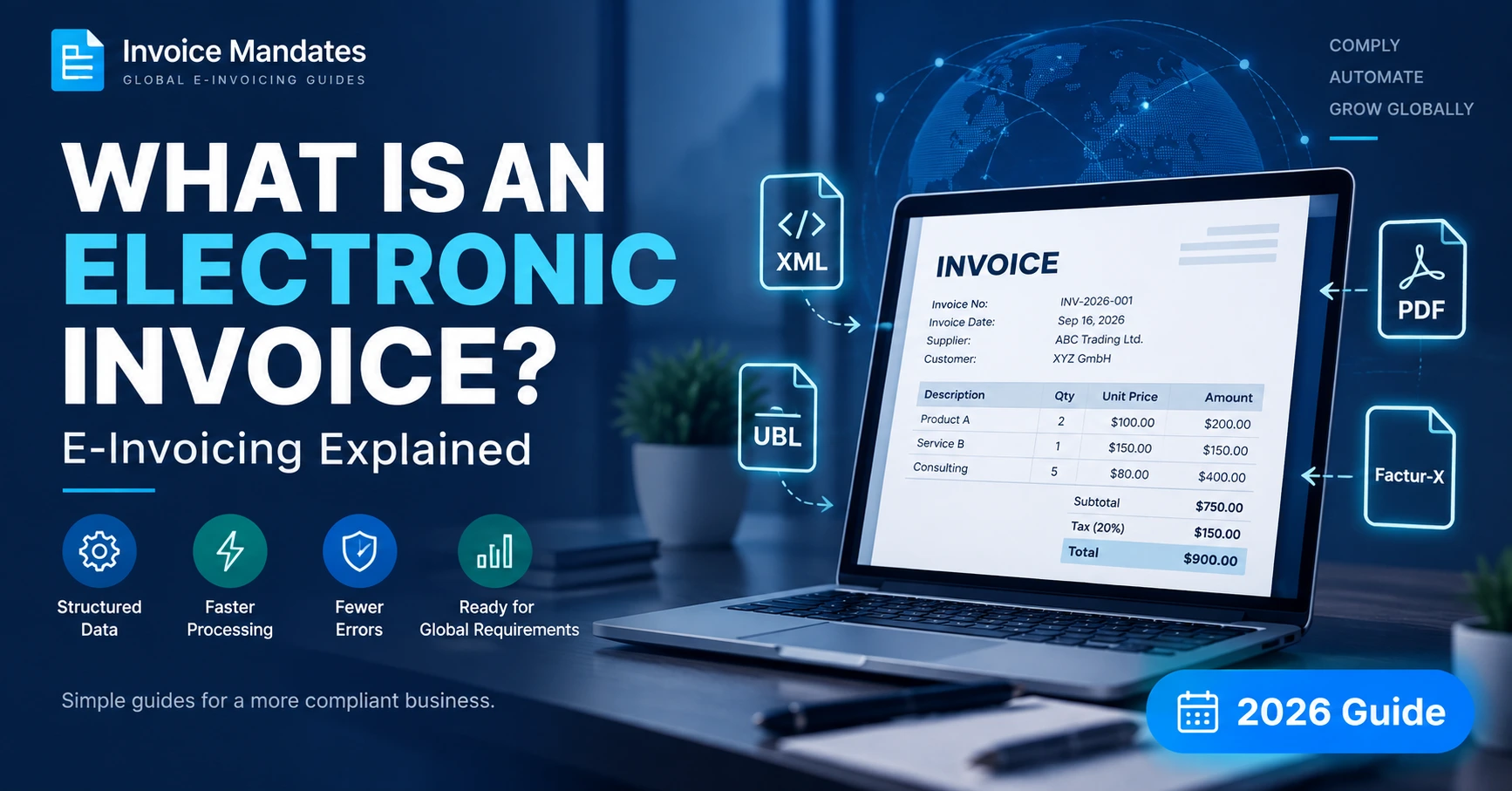
An electronic invoice, often called an e-invoice, is an invoice created, sent and received in a structured electronic format that allows computer systems to process the invoice data automatically.
This is different from simply creating an invoice as a PDF and emailing it to a customer. A structured e-invoice contains information such as the supplier, customer, invoice number, tax amounts, line items and payment details in clearly defined data fields that accounting software can read.
Quick answer: An electronic invoice is a machine-readable invoice that can move directly between accounting or invoicing systems. A normal PDF invoice is digital, but it is usually not a structured e-invoice.
What is an electronic invoice?
An electronic invoice is a digital invoice designed for both computers and businesses to process electronically.
Instead of presenting invoice information only as text positioned on a page, an e-invoice places important information into structured fields. This means software can identify the invoice number, supplier details, customer information, tax, totals and other data without someone manually typing everything into an accounting system.
A structured electronic invoice can therefore move from a supplier’s billing system to the customer’s accounting system with much less manual work.
What information does an e-invoice contain?
The exact information required depends on the country, tax system and type of transaction. However, a typical electronic invoice can contain:
- supplier name and address;
- customer name and address;
- tax or VAT identification numbers;
- invoice number;
- invoice date;
- delivery or supply date;
- description of goods or services;
- quantities;
- unit prices;
- discounts;
- tax rates and tax amounts;
- invoice total;
- payment terms;
- currency;
- bank or payment information; and
- references such as purchase-order numbers.
Some countries require additional fields for their own tax or reporting systems.
How does electronic invoicing work?
The exact process varies by country, but a typical e-invoicing workflow looks like this:
- The supplier creates the invoice. Invoice information is generated in accounting, billing or ERP software.
- The invoice is converted into a structured format. The system creates the required machine-readable invoice data.
- The invoice is validated. Software may check required fields, identifiers, totals and technical formatting.
- The invoice is transmitted. It may travel through an e-invoicing network, approved service provider, government platform, API or another permitted channel.
- The customer receives the structured invoice. The customer’s system can import the invoice data automatically.
- The invoice is processed. It can enter accounting, approval, payment and record-keeping workflows.
Some countries also require invoice or transaction information to be sent to the tax authority.
Electronic invoice vs PDF invoice
A PDF invoice and an electronic invoice can look similar when viewed on a screen, but technically they are different.
| Feature | PDF Invoice | Structured E-Invoice |
|---|---|---|
| Main purpose | Designed mainly for people to read | Designed for automatic computer processing |
| Data structure | Usually unstructured visual text | Information stored in defined data fields |
| Automatic processing | Usually requires OCR, extraction or manual entry | Can be imported directly into compatible systems |
| Typical delivery | Email attachment or download | Network, platform, API or structured file exchange |
| Mandate compliance | May not qualify when structured invoicing is required | Can qualify when it follows the required format and transmission process |
For a more detailed comparison, read our E-Invoice vs PDF Invoice guide.
Is every digital invoice an e-invoice?
No.
The word “electronic” can sometimes cause confusion. An invoice may exist electronically without being a structured electronic invoice.
For example, these are usually digital documents but are not automatically structured e-invoices:
- a normal PDF attached to an email;
- a scanned paper invoice;
- a JPG or PNG image of an invoice;
- a Word document;
- an Excel spreadsheet sent as an invoice; and
- invoice information written directly inside an email.
Whether a particular format is legally acceptable depends on the invoicing rules that apply in the relevant country.
What is a structured electronic invoice?
A structured electronic invoice stores invoice information using a standard data structure that software can understand.
Instead of telling a computer to look at a particular position on a page and guess what the number means, the structured file identifies the meaning of the data directly.
For example, the system can identify a value specifically as:
- invoice number;
- invoice date;
- supplier VAT number;
- customer identifier;
- tax rate;
- net amount; or
- total amount payable.
This structure makes automatic validation and accounting much easier.
Common e-invoice formats
There is no single electronic-invoice format used everywhere in the world.
Common formats and standards include:
UBL
Universal Business Language (UBL) is an XML-based standard used for electronic business documents, including invoices. It is widely used in e-invoicing systems and networks.
CII
Cross Industry Invoice (CII) is another structured invoice standard used in European electronic-invoicing frameworks.
Factur-X and ZUGFeRD
Hybrid invoice formats can combine a human-readable PDF with embedded structured XML data.
France commonly uses the name Factur-X, while Germany uses ZUGFeRD. The structured component is what allows the invoice to be processed electronically.
Facturae
Facturae is a structured electronic-invoice format used in Spain, particularly in public-sector electronic invoicing.
The format a business needs depends on the rules of the country, customer and invoicing system involved.
What is an e-invoicing network?
An e-invoicing network allows different businesses and accounting systems to exchange structured invoices electronically.
Instead of requiring the supplier and customer to use exactly the same accounting software, a network can connect different systems through agreed technical rules.
Peppol is one of the best-known examples. It is used in a growing number of countries to exchange invoices and other business documents.
We explain this separately in our What Is Peppol? guide.
Does electronic invoicing always use Peppol?
No.
Peppol is an important international network, but not every country uses it as the main e-invoicing route.
Different countries use different models.
For example:
- Belgium uses Peppol as a major route for its structured B2B e-invoicing mandate;
- Poland uses the national KSeF platform;
- Italy uses Sistema di Interscambio, or SDI;
- Singapore uses InvoiceNow, which is based on the Peppol framework;
- France uses approved platforms and a national directory; and
- Germany currently permits several transmission methods for domestic B2B invoices.
Businesses should therefore check the rules of the specific country rather than assuming one network works everywhere.
Why are countries introducing e-invoicing?
Governments and businesses are adopting structured electronic invoicing for several reasons.
Less manual data entry
Structured invoice information can move directly between systems, reducing the need for employees to retype supplier invoice data.
Faster processing
Invoices can enter approval and accounting workflows automatically instead of waiting for someone to download, open and enter a document manually.
Fewer formatting errors
Standard fields and automated validation can identify missing or incorrectly formatted information before an invoice reaches the next stage.
Better tax reporting
Some governments use e-invoicing systems to improve VAT reporting, transaction visibility and tax administration.
More consistent records
Structured invoice data can make searching, reconciliation, reporting and audit processes easier.
Does e-invoicing mean invoices are sent directly to the tax authority?
Not always.
E-invoicing systems use several different models.
In some countries, invoices or invoice data pass through a government platform. In others, approved private providers exchange invoices and report certain information to the tax authority. Some jurisdictions use networks without real-time government clearance.
It is therefore important to distinguish between:
- electronic invoice exchange;
- tax reporting;
- invoice clearance;
- continuous transaction controls; and
- ordinary invoice storage.
These concepts can work together, but they are not always the same requirement.
Is electronic invoicing mandatory?
That depends on the country and transaction.
Some jurisdictions already require structured electronic invoices for certain domestic B2B transactions. Other countries are introducing phased requirements based on business size, turnover, tax status or transaction type.
Public-sector invoicing can also follow different rules from private-sector invoicing.
For example, a country may require:
- B2G e-invoicing but not yet B2B;
- e-invoicing only for VAT-registered businesses;
- mandatory receipt before mandatory issuance;
- a phased rollout based on turnover; or
- a specific national platform.
Visit our country comparison section to explore different e-invoicing requirements.
How businesses can prepare for e-invoicing
- Identify the countries involved. Check where your legal entities, customers and suppliers are established.
- Review the rules for each country. Do not assume that the same format, platform or deadline applies everywhere.
- Check your invoicing software. Find out which structured formats and networks it supports.
- Review customer and supplier data. Correct tax IDs, company names, addresses and electronic invoice identifiers.
- Choose the correct transmission method. This may involve Peppol, a government portal, an approved platform or another permitted route.
- Test sending and receiving. Confirm that structured invoices can move correctly between systems.
- Plan invoice storage. Preserve the original structured invoice and any records required by local law.
- Train staff. Finance, accounting, purchasing and sales teams should understand the new process.
- Monitor regulatory updates. E-invoicing deadlines and technical requirements can change.
Common e-invoicing mistakes
- Assuming every PDF is an e-invoice. A PDF is usually not a structured invoice.
- Using the same rules for every country. E-invoicing systems differ significantly between jurisdictions.
- Focusing only on sending invoices. Some regulations require businesses to be able to receive structured invoices as well.
- Ignoring customer identifiers. Incorrect IDs can prevent automated invoice routing.
- Deleting the structured file. Keeping only a printed or PDF copy can remove important machine-readable information.
- Waiting until the mandatory date to test. Software integration and data problems are easier to fix before a deadline.
Frequently asked questions
What does e-invoice mean?
An e-invoice is an invoice issued, transmitted and received electronically in a structured format that allows automatic electronic processing.
Is a PDF invoice an electronic invoice?
A PDF is a digital invoice document, but it is usually not a structured e-invoice. Where a mandate specifically requires structured electronic invoicing, an ordinary PDF alone may not be compliant.
What is the difference between an invoice and an e-invoice?
A traditional invoice may be paper or an unstructured digital document. An e-invoice stores invoice information in structured data fields that software can process automatically.
Can an e-invoice be read by a person?
Yes. Accounting software or an invoice viewer can display structured invoice data in a readable layout. Hybrid formats can also combine structured XML data with a visible PDF.
What format does an e-invoice use?
It depends on the country and system. Examples include UBL, CII, Facturae, XRechnung and hybrid formats such as Factur-X or ZUGFeRD.
Do all countries use Peppol?
No. Peppol is used in many e-invoicing systems, but countries can also use national tax platforms, approved provider networks or other transmission models.
Do small businesses need e-invoicing?
In some countries, yes. Business size does not automatically create an exemption. Other countries use turnover thresholds or phased implementation dates.
Can electronic invoicing reduce manual work?
Yes. Structured invoice data can be imported into compatible accounting systems and used in automated validation, approval and payment workflows.
Is e-invoicing the same as real-time tax reporting?
No. A country can require structured electronic invoices without requiring every invoice to be cleared by a tax authority in real time. The reporting model depends on the jurisdiction.
Where can I check whether e-invoicing is mandatory?
Check the official tax authority, finance ministry or government e-invoicing portal for the country concerned. You can also use the country guides on Invoice Mandates as a starting point.
Official resources and further reading
- European Commission: What Is E-Invoicing?
- EUR-Lex: Directive 2014/55/EU on Electronic Invoicing
- Belgian Government: What Is an Electronic Invoice?
- OpenPeppol
Continue reading
Learn more about the difference between structured and visual invoices in our E-Invoice vs PDF Invoice guide.
You can also read our What Is Peppol? guide to understand how businesses exchange structured invoices through an international network.
For country-specific rules, explore our guides to Belgium, France, Germany, Poland and Singapore.
Disclaimer: This guide provides general educational information and does not constitute tax, accounting or legal advice. Electronic-invoicing definitions, formats, deadlines and technical requirements differ by jurisdiction and can change. Confirm important compliance decisions with the relevant government authority or a qualified professional.